


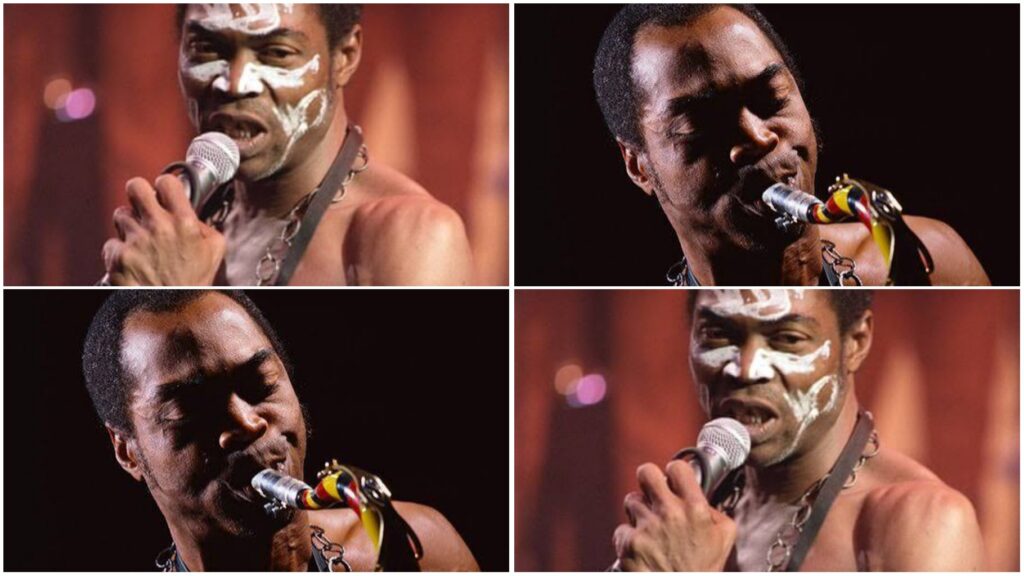
As debates over who deserves the title of the “New Fela” trend once again on Nigerian social media, one fact continues to be ignored: Fela Anikulapo-Kuti was never meant to be replaced.
The argument resurfaces with every new Afrobeats superstar, but history tells a different story. Fela did more than make music; he built a movement.
Before global charts, brand deals, and streaming numbers, Fela popularized Afrobeat, a genre rooted in Yoruba rhythms, jazz, funk, and highlife, designed as a tool of resistance. His music was not made for comfort, it was made to confront power.
Today’s stars operate within Afrobeats, a modern, commercial sound shaped for global audiences. The connection is musical, but the mission is not the same.
As fans continue to compare stars like Wizkid and Burna Boy to Fela, Afrobeat musician Seun Kuti has repeatedly drawn a firm line between influence and equivalence.
Speaking on the Hits Don’t Lie podcast, Seun stated plainly: “Sampling Fela doesn’t make you Fela.” And that distinction matters.
Fela made music under military rule, when criticism came with brutal consequences. He declared Kalakuta Republic as a free state, openly challenged Nigerian governments, and named corruption and oppression directly in his songs. The price was severe: arrests, beatings, prison time, and the destruction of his home. His mother, Funmilayo Ransome-Kuti, later died from injuries linked to a military attack on his compound. This was sacrifice, and not branding.
So when fans call Fela “untouchable”, they are not talking about awards or numbers. They are talking about a man who refused to bow, even when it cost him everything.
A fan, Kolade Tobi, summed it up clearly: “Fela is untouchable in terms of historical and societal impact. He wasn’t just a musician; he was a movement, a political force, and a cultural revolution.”


However, this is where most comparisons collapse. Wizkid’s impact is real. He represents Afrobeats at its global peak; chart dominance, international collaborations, sold-out arenas, and cultural export. He helped move Nigerian music from local relevance to global recognition. That achievement is historic, but it is different, not identical.
Wizkid mastered the global market while Fela fought the system. One expanded culture across borders and the other challenged power at home.


Even artists often placed in the comparison understand this gap. Burna Boy once said: “Fela Kuti is the blueprint for African giants. He didn’t just make music; he built a movement that shook empires.”
That blueprint is now receiving formal recognition. In the coming days, the Grammys will honour Fela Anikulapo-Kuti with a Lifetime Achievement Award, an honour reserved for very few artists whose influence transcends generations.
What This Means for Afrobeats
This debate says more about Afrobeats than it does about Fela.
Afrobeats today is global, profitable, and celebrated as it thrives on reach, numbers, and moments. That success deserves praise, but Fela represents the root; music as ideology, confrontation, and truth.
Afrobeats does not need another Fela, it only needs a deeper understanding of Fela. Because in the end, you can inherit a sound, but you cannot inherit a struggle.